.png)
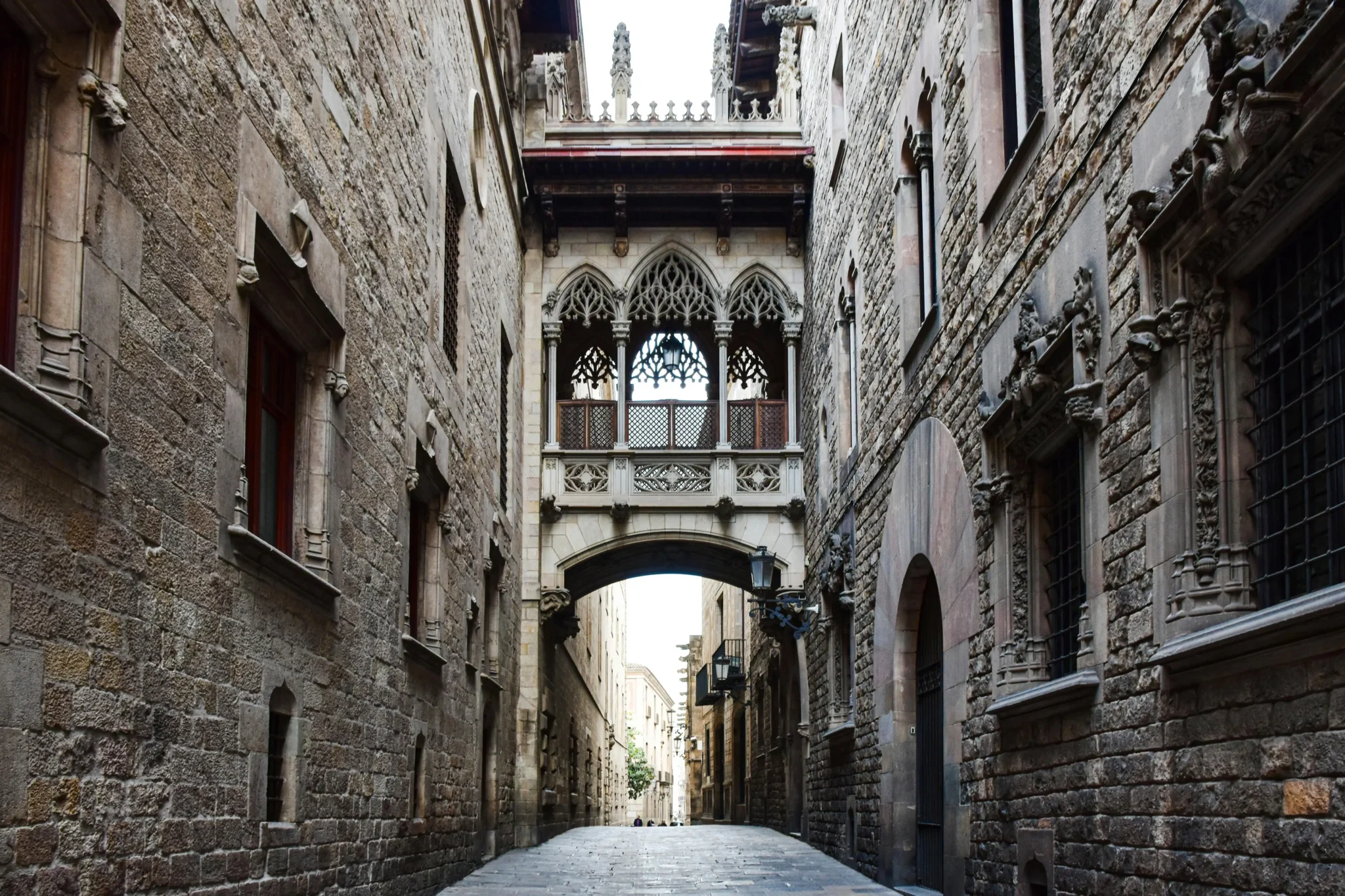
Every neighbourhood in Barcelona has a unique personality and appearance. Walking from district to district feels like entering a different world altogether with their own unique architectural styles to explore. From the modernista neighbourhood of L'Eixample to the bohemian streets of Gracia, you can really find it all. But perhaps one of the most interesting areas to explore is the famed Barcelona Gothic Quarter or 'Barrio Gòtic'. This part of town is where you'll find cobblestone covered medieval alleys, towering neo-gothic spires and even ancient Roman ruins.
History
Despite the name "Gothic Quarter", it's important to know that most of these buildings were actually built in the late 1800s through the 1900s in neo-gothic style. In 1929 there was a massive International Exhibition planned to take place in Barcelona. Wanting to jump on the tourist train, Barcelona decided to pour all their money into a massive restoration project. This project aimed to recreate the feeling of Barcelona in the medieval ages. They were inspired by European neo-gothic architecture and wanted to bring back some of their destroyed medieval histories.
While many of the sights might not date back to the early 13th century, this neighbourhood is wonderfully charming and contains some of Barcelona's most important architectural structures. Plus, with these renovations, you do get the sense of what it would have felt like to explore Barcelona of the 13th century.
The neighbourhood retains its medieval labyrinth-like street layout. Most of these streets are still closed off from traffic, as they would have been before the invention of cars. A walking tour is the best way to experience all the sights and sounds this place has to offer.
When to do this Tour?
The best time to take this walking tour is early in the morning. Since the area is so popular, it becomes overrun with tourists in the afternoon. There is just something about exploring in the early morning, when you have the entire place to yourself, which feels absolutely magical. Try to avoid the weekends as they can also be a busier time to visit.
How to Get There
The tour starts at the Plaça de Catalunya. You can easily reach the square on foot if you are staying nearby. Catalunya Station is serviced by Lines 1, 3, 6 and 7. Just take the metro to Catalunya Station, hop off and follow the signs for Plaça de Catalunya.
Accessibility
Barcelona is heralded as one of the most wheelchair accessible cities in the world. In the gothic quarter, there are more bumps and hills than in the rest of the city, but with a powered chair, this shouldn't be an issue. The Gothic Quarter is fairly small, so although we may weave around these streets, we won't be going a huge amount of distance.
Plaça de Catalunya
The best place to start your tour is at the Plaça de Catalunya. Built in 1927, just before the 1929 International Exhibition, it would become the central meeting point where people would gather from the moment it was inaugurated. Surrounding this plaza were the city's most expensive and exclusive hotels, bars and theatres. The enormous plaza covers 5 hectares of land. Nine different major streets all converge together at this plaza. This place is always packed with locals eating lunch, tourists taking pictures and street artists performing.
One of the nicest features of the plaza is the number of sculptures surrounding it. One of the most impressive is Jose Maria Subirachs' '1991 Monument to Francesc Macià'. The normal staircase represents Catalonia's history while the upside-down stairs represent the dynamic future of the Catalonian people.
Avinguda del Portal de l'Àngel
Move towards the southeastern corner of the square towards Avinguda del Portal de l'Àngel. The Portal de l'Àngel is a beautiful pedestrian street that leads you into the Gothic Quarter. It runs parallel to Las Ramblas and while Las Ramblas might be a little more touristy, Angel is as upscale as it gets in Barcelona. When the street was first established, it was the main hub for the fashion industry. Nowadays, you can find some of the most expensive brands and department stores along this stretch.
Santa Anna de Barcelona
Making your way down the Carrer de Santa Anna, on your right keep your eye open for an unassuming archway. This leads you towards one of the most underrated churches in Barcelona. Tucked in between a few residential buildings and almost lost in an overgrown forest of trees, this church doesn't immediately look like much — but a step inside will reveal its hidden beauty.
The church was founded in 1177 by the monks of the Holy Sepulcher who travelled to Barcelona all the way from Jerusalem. It took over three centuries to build. Because of the length of time of construction, you can find elements from multiple architectural periods — from Romanesque to Gothic and even bits from the Renaissance.
The most impressive part of this church is the 15th-century cloisters, designed in traditional gothic style. In the centre of the cloisters is a beautiful tropical garden with large palm trees and other seasonal plants.
Els 4 Gats
Els 4 Gats, or 'The Four Cats', is a gorgeous modernista cafe located just a few blocks away from the church. It opens as early as 9am and is the perfect place to grab a coffee in the most beautiful setting. The cafe was opened in 1897 and was once both hostel, bar and cabaret. This was where Barcelona's creative community would gather. It's been mythologized that Pablo Picasso and Ramon Casas i Carbó were both local patrons.
Font de Santa Anna de Barcelona
At the corner of Avinguda Portal de l'Àngel and Carrer Cucurulla you'll find the Font de Santa Anna de Barcelona. The fountain dates all the way back to 1356 and was originally used as a horse trough. In the 18th and 19th centuries, ceramic tiles were added on each side of the fountain depicting women carrying water jugs. On the front of the fountain is a stone carving of Barcelona's coat of arms — the 19th-century version, with a large bat that flies over the crown.
Plaça Nova
Continuing along the Carrer dels Arcs you'll come upon the large public square called Plaça Nova. Plaça Nova sits in the shadow of the great Barcelona Cathedral and is almost always bustling with people. The Placa Nova was once one of the four main entrances to the Roman city. We can still see remnants of the original Roman city walls and two large Romanesque towers surrounding the square. In the centre of the square are the letters "B a r c i n o" — the original Iberian village which would become Barcelona.
Turn around to face the Architects' Association of Catalonia building where you'll find one of the largest pieces by Pablo Picasso. This enormous frieze was designed by the iconic artist but painted by his studio.
La Casa de l'Ardiaca
Inside the Plaça Nova, hidden behind the original Roman ruins, you'll find the Casa de l'Ardiaca. The building has been the home of the Municipal Archive since 1921 but its history dates back to almost the 12th century. Outside, you'll see a modernista style mailbox designed by famed architect Lluís Domènech i Montaner. On it are three swallows and a tortoise — the birds symbolize freedom, while the tortoise represents the slow bureaucratic procedures of legal proceedings.
Head inside the main courtyard to see a gorgeous central fountain and palm tree growing inside the building. The surrounding cloisters are covered in colourful tiles and the oldest looking walls here date all the way back to the Roman era.
Cathedral of Barcelona
Continue walking across the square until you reach the doors of the great Cathedral of Barcelona. This monument to architectural majesty began construction in 1298 but wasn't completed until 1420. The church is dedicated to Saint Eulalia of Barcelona. Inside you can still see her chapel which holds her elaborate sarcophagus. This church helped inspire Gaudi's design of the Sagrada Familia, so seeing this gothic masterpiece is the perfect complement to understanding Gaudi's vision.
Monument to the Heroes of 1809
Exit the church via the side exit in the cloister, where you'll come out into a small courtyard. In the centre, along the wall, is a large arch with a beautiful sculpture nestled underneath. This stunning modernist sculpture is dedicated to the 'Five martyrs of Catalan Freedom'. During the French occupation of 1809, these five men rose up in an attempt to free the city from the Napoleonic troops. Sculptor Josep Llimona captured the quiet moment just before they were executed. Above their heads are a choir of angels made by sculptor Vicenç Navarro.
Plaça de Sant Felip Neri
Continue down the Carrer de Sant Sever and turn up the small side street Carrer de Sant Felip Neri. Walking into this small, quiet square, the first thing which grabs your eye is the huge stone walls covered in holes. In 1937, bombs were dropped by fascist troops into this square, resulting in the death of 42 people, 20 of whom were children. The holes on the walls still mark this deadly event, left unrepaired so that the event is never forgotten.
On the northern wall is the old 17th-century baroque church of Felip Neri. Opposite the church is the oldest building in the square, from the Renaissance period, notable for its two ancient wrought-iron balconies and a stone relief of a lion in the center — once the headquarters of the shoemaker guild and now housing the Barcelona shoe museum.
Pont del Bisbe
Head back out onto the Carrer de Sant Sever turning east onto the Carrer del Bisbe. As soon as you turn the corner, your eyes will be met with the sight of this fantastical gothic bridge which adjoins the two buildings on either side of the narrow street. This is the Pont del Bisbe, or Bishop's Bridge. It was created in the 1920s to connect the Parliament buildings to the presidential residence. The intricate patterns of stonework beneath the arches make the bridge look like a delicate piece of lace. The bridge was designed by Joan Rubió i Bellver, the apprentice to Antoni Gaudí. When you walk under the bridge make sure to make a wish as is the popular tradition!
Statue of Saint Jordi
After walking under the bridge, look up at the wall to your right. Along the top of this facade is a gothic medallion and in the centre a small statue of Saint Jordi, made in the 15th century by Catalan sculptor Pere Johan. The legend goes that a valiant knight rescued a princess from a ruthless dragon — when he plunged his sword into the dragon's belly, a rose bush grew from the spilt blood. In Barcelona, every year on April 23rd they celebrate Saint Jordi Day, the holiday of love, on which lovers exchange roses and books.
Cases dels Canonges
Turn back around to walk down the Carrer de la Pietat. This small street takes you behind the great Cathedral of Barcelona and along the Cases dels Canonges, or House of the Canon. This 14th-century group of buildings was transformed into the residence of the President of Catalonia in the 20th century. Along the facade you'll see a myriad of architectural designs — from Renaissance, to Gothic and even a touch of Baroque. Above the archway is a powerful portal depicting the Pietat; mother Mary holding her dying son in her arms after taking him down off the cross.
Temple of Augustus
Walk down the small Carrer del Paradis. This secretive, almost too narrow alley leads you straight to the Temple of Augustus. Head into the inner courtyard to find an impressive discovery: this medieval building holds within it four incredible Corinthian columns — the last remaining piece of Barcelona's Roman history. The Roman temple which once stood here was dedicated to Emperor Caesar Augustus.
Plaça de Sant Jaume
Just opposite the tiny street of Carrer del Paradis is the grand square called Plaça de Sant Jaume. This huge, black-bricked square is surrounded on all sides by important historical buildings. They call this square the "political beating heart of the city". Even during Roman times, Plaça de Sant Jaume was the major meeting point in Barcelona. The square was named after the old Church of Sant Jaume, which stood here since the 14th century but was demolished in 1823.
Palau de la Generalitat
The square is where you'll find the Parliament of Catalonia, or the Palau de la Generalitat. This is one of the few medieval buildings to remain in the gothic quarter. The Palace was built in 1283 to hold the Catalan Assembly and was the first parliament building in Europe. Above the large archways is a statue of St. George slaying the dragon.
Barcelona City Hall
Opposite the Palau de la Generalitat is the grandiose Casa de la Ciutat, or Barcelona City Hall. It features a rather austere neoclassical facade but inside is replete with gothic architecture exemplifying Catalan national pride. On either side of the archway entrance are the statues of King Jaume I and Joan Fiveller. You can walk inside, where you'll find the Barcelona Tourism office and a great Gothic staircase with sculptures from Gargallo, Llimona, Navarro, Subirachs, Marès, Miró and Clarà.
Basilica of Saints Justus and Pastor
Walk north along the Carrer d'Hèrcules towards the Plaça de Sant Just. Standing guard over the square is the great Basilica of Saints Justus and Pastor. Look up the portal above the central doorway — two tiny angels kneel in prayer on either side of the Virgin Mary. The 14th-century church is rumoured to be even older, perhaps built upon an older church as far back as the 4th century, which would make it the oldest church in Barcelona.
Font de San Just
There is a small water fountain in the corner of the square. At the bottom of the fountain are three carved heads with their mouths open and water faucets in between. Although the faucets and the carvings are new, the source of the water is the oldest in the city — giving credence to the thought that the church here might date back to the founding of the city.
Plaça del Rei
Continuing back towards the starting point of the tour along the Carrer de la Dagueria and the Carrer del Verguer, you'll arrive at the Plaça del Rei. This square is surrounded on all sides by some of the most authentically gothic and medieval buildings of Barcelona. The wide, regal steps lead up towards the Palau Reial Major, or old Royal Palace — the main residence of Catalan Kings and Queens from the 13th to 15th centuries. Standing guard above the square is King Martin's Watchtower, built in the 15th century.
The building opposite the palace is the Palau del Lloctinent, or Lieutenant's Palace. This 16th-century construction hides inside it one of the most heavenly gardens — an old Renaissance courtyard covered in green ivy and flourishing plants. Today, this building houses the Archive of the Crown of Aragon.
This is a great place to end the tour. If you want to relax there are dozens of cafes nearby with gorgeous views of the Gothic Quarter. Or if you're still up for more, you can visit the Barcelona History Museum to learn even more about the history of this great city!